


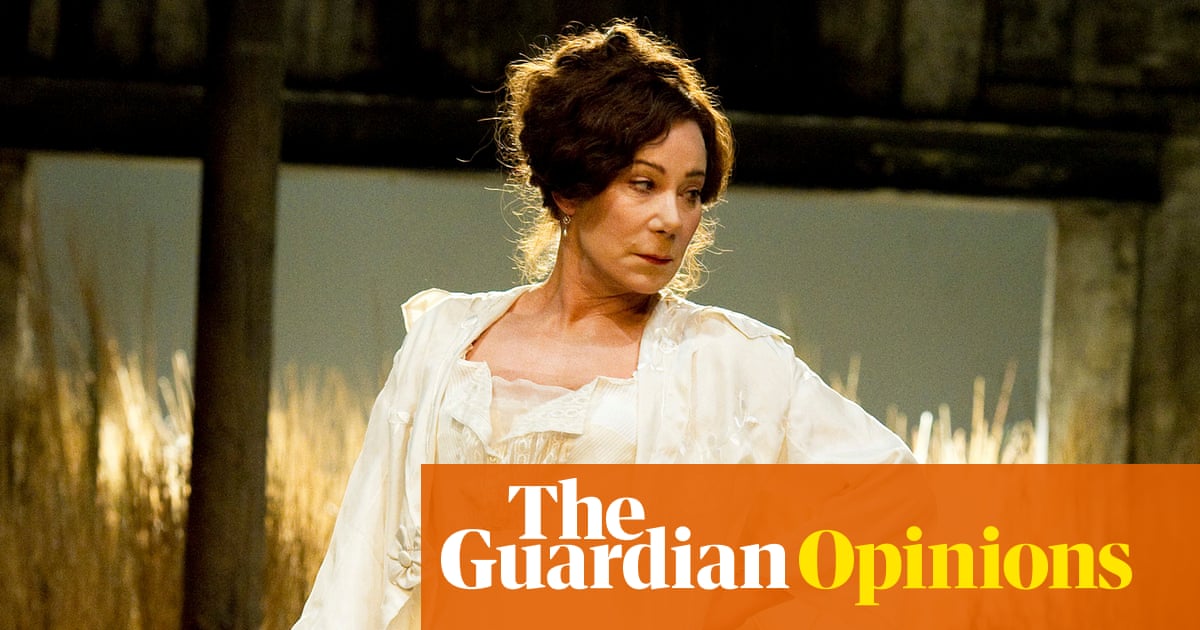
What type of play is The Cherry Orchard? As a brand new manufacturing starring Helen Hunt and Kenneth Branagh beckons in Stratford, I’m reminded that it’s a query folks have been asking for the reason that play’s inception. Chekhov himself wrote that what had emerged in his play was “not a drama however a comedy, in locations virtually a farce”. Stanislavski, who directed the Moscow premiere in 1904, violently disagreed. “It’s a tragedy,” he advised Chekhov, “no matter prospect of a greater life you maintain out within the final act.”
Whereas the controversy continues, I hope we will not be advised by anybody concerned within the new RSC manufacturing that they’re in the end restoring the play’s comedy. It’s a vital cliche that the British sentimentalise the play and deal with it as a lament for the decline and fall of a pseudo-Edwardian aristocracy. In my expertise of the play – and I’ve seen about 20 productions – that is merely unfaithful. We typically do The Cherry Orchard very effectively as a result of its mix of types and moods is one thing baked into our personal dramatic heritage. Eschewing the educational formality of the French, for whom tragedy and comedy are rigidly outlined genres, we’re used to a wonderful impurity in drama: a tradition that may produce Twelfth Evening should not have any downside in comprehending The Cherry Orchard.
I first noticed the play in 1961 in an RSC manufacturing directed by Michel Saint-Denis. It was stuffed with laughter, not least within the ethereal nonchalance of John Gielgud’s Gaev as he ridiculously claimed, “I shall be a financier”: he’s going to work in a financial institution. However, equally, I’ve by no means forgotten the look of haunted sorrow on the face of Dorothy Tutin’s Varya as she knelt downstage packing a trunk, awaiting the wedding proposal from George Murcell’s Lopakhin that by no means got here. Even that had its comedian aspect as Murcell fumbled with the doorknob making an attempt to make his escape.
The critic Eric Bentley, as so usually, acquired it proper when he stated there may be nothing nebulous about Chekhov: he’s, if something, exact. That has been the hallmark of British productions. Michael Blakemore did a tremendous model for the Nationwide Theatre in its Previous Vic period the place he made the destruction of the cherry orchard appear a part of an inevitable historic course of. On the identical time, there was a relentless thread of humour with the revolutionary Trofimov speaking of mankind’s wrestle in the direction of a larger reality whereas wrestling hopelessly along with his galoshes.
Mike Alfreds did an much more radical model for the Nationwide in 1985 that caught completely the emotional contradictions which might be important to Chekhov. Ian McKellen’s Lopakhin, having made his buy of the property, gloatingly whirled the home keys above his head as if about to poke out somebody’s eye after which rushed over to consolation Sheila Hancock’s weeping Ranyevskaya.
Steeped in Shakespeare, British actors are significantly good at pinning down the sudden shifts of temper which might be pervasive in Chekhov. Penelope Wilton’s Ranyevskaya in a 1995 RSC manufacturing was one second gigglingly imitating the crocodiles she claimed to have eaten in Paris and the following extending a hand for David Troughton’s stooping Lopakhin to kiss within the method of a grand duchess. Those self same contradictions had been evident in Zoë Wanamaker’s efficiency of the function in Howard Davies’s 2011 Nationwide manufacturing: having known as Mark Bonnar’s Trofimov, in Andrew Upton’s brutal model, “retarded” she instantly smothered him in consoling embraces.
What I’m saying loudly and clearly is that the British are superb at Chekhov. However, if there may be one manufacturing of The Cherry Orchard that haunts me, it’s the one Peter Stein created for the Berlin Schaubühne in 1989. In a programme observe, Stein described the play, Polonius-like, as “Tragedy. Comedy. Pastoral. Farce” and he pushed every class to the boundaries. The farce was blatantly farcical with the get together within the third act buying a Gogolian absurdity as very quick males danced with excessively tall girls. The pastoral factor was epitomised by the breathtaking second within the first act when the shutters of the nursery had been flung open and we noticed a profusion of white cherry blossom that made you realise, as by no means earlier than, why the household couldn’t bear to half with the property.
Stein had the type of sources, rehearsal time and ensemble which might be merely not obtainable to British administrators. For all that, we nonetheless have a temperamental and stylistic affinity with Chekhov. With two new productions of his final and best play due – first in Stratford-upon-Avon after which within the West Finish with Kristin Scott Thomas within the autumn – you may say that the time is ripe for extra Cherry Orchards.

