


Picture-Illustration: Vulture; Pictures: Everett Assortment (Chris Harris/A24, Neon, Macall Polay/Walt Disney Studios, Amazon MGM Studios)
Vulture’s critics are monitoring the highlights of this yr in movie, from blockbuster diversifications to low-budget originals and the whole lot in between. Verify again every month for the newest additions. Motion pictures are organized chronologically by their U.S. theatrical-premiere date with the latest on the prime.

Picture: Alex Bailey/Focus Options/Everett Assortment
Based mostly on true occasions, this gripping WWII story follows the efforts of a stiff-upper-lip British meteorologist, Group Captain James Stagg (Andrew Scott), to forecast the climate for the D-Day Normandy invasion of 1944. Hounded by a loud, impatient Dwight D. Eisenhower (Brendan Fraser) and confronted with very actual proof {that a} brutal trio of storms will make an early June invasion unimaginable, Stagg is torn between doing his responsibility and, nicely, doing his responsibility. If D-Day is canceled, the Allies will lose the battle. But when D-Day goes on, the enormous waves and insane winds will guarantee its catastrophic failure and the lack of numerous males and vessels. That’s an important (true-life) battle, and the script successfully strips the complicated affair all the way down to its compelling cinematic necessities: On one aspect are the partying, carefree American forecasters, led by Colonel Irving Krick (Chris Messina), who’ve checked out a half-century’s price of previous climate maps and predicted that D-Day might be sunny and clear. After which there’s the prim and unfriendly Stagg, who doesn’t play nicely with others, however we perceive that his standoffishness is due partly to his nerves and the truth that he needed to go away his pregnant spouse again dwelling earlier than taking over this top-secret job. The movie is a mannequin of narrative economic system and clear character improvement, all grounded and enhanced by Scott’s delicate efficiency. —BE

Picture: Neon/Everett Assortment
In typical Boots Riley style, the musician and filmmaker’s I Love Boosters is filled with large, wacky, leftist concepts, however amid all the colourful manufacturing design and uniquely huge pictures made doable by customized Panavision lenses, most of Riley’s arguments are pretty accessible: Shoplifting is ok as a result of megacompanies led by billionaires are the precise thieves of our labor, creativity, and time; quick style is constructed on inhumane practices; neoliberalism insists that we’re all singular snowflakes who can specific ourselves via what we put on, when in actuality our energy comes from collectivism. Riley hasn’t been shy about expressing any of those concepts, and all of his screenwork till this level, together with 2018’s Sorry to Trouble You and 2023’s I’m a Virgo, builds towards an endorsement of collective motion. A Riley venture is all the time going to finish in the identical sort of narrative place. Earlier than then, although, I Love Boosters has a charmingly gonzo throw-it-at-the-wall high quality that looks like a distinctly new expression of Riley’s bigger cinematic and ideological visions. How Riley maneuvers all of the movie’s components in service of its message is in contrast to anything you’ll see this yr — or at the least till his subsequent film. —RH

Picture: Alan Markfield/Black Bear Footage/Everett Assortment
Daniel Roher’s offbeat crime drama follows a supernaturally proficient piano tuner (Leo Woodall) with a listening to situation that makes his ears so delicate he has to spend his day carrying headphones. This additionally makes him a gifted protected cracker, and he falls in with a bunch of sleazy “safety consultants” who make a residing by lifting minor, forgettable valuables from the collections of their purchasers. It’s the sort of setup we all know gained’t finish nicely, however the attraction of Roher’s movie lies in the way in which it reveals its hero discovering a world of chance as he falls in love with an exquisite music graduate pupil (Havana Rose Liu) who reconnects him to his personal ardour for music. Everyone on this film is difficult (together with the aforementioned hapless goons), which makes its inevitable darker plot turns that rather more suspenseful and heartbreaking. Not like most modern style flicks, Tuner throbs with life. —BE
Picture: Vertical Leisure
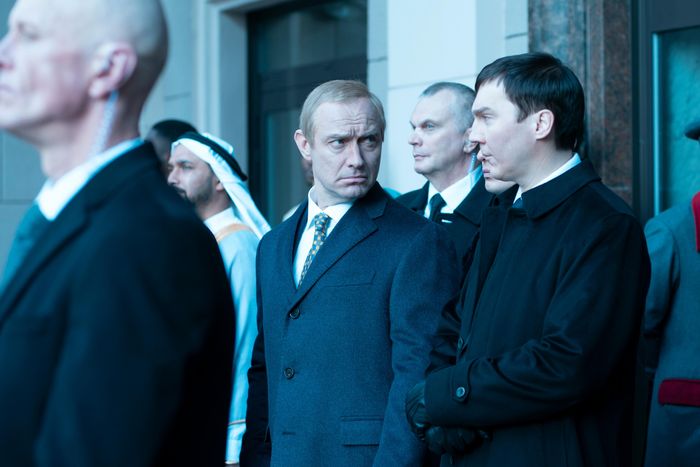
In Olivier Assayas’s movie, Jude Legislation performs Vladimir Putin throughout twenty years of latest Russian historical past, giving him a riveting dismissiveness that serves this brusque, cold-eyed technocrat nicely. As he goes from intelligence chief to bold politician and, lastly, paranoid tyrant, we begin to see how such a small man wound up amassing a lot energy and loyalty. Putin isn’t the protagonist of this movie, nonetheless. That honor goes to Vadim Baranov (Paul Dano), the so-called new Rasputin, a former media man who helped engineer Putin’s rise. The Wizard of the Kremlin reveals how he started his profession as a younger artist intoxicated with the openness of the post-Soviet years, then a TV exec making the most of Russians’ shifting attitudes about leisure and knowledge. This results in his changing into a political guru with the ability to invent actuality: As Putin’s chief strategist, he finds methods to create public opinion, first in Russia after which the world. One in all Assayas’s ongoing themes has been the way in which individuals grow to be absorbed by the realities they create, which provides a captivating layer to this story of a political manipulator who finally doesn’t understand he’s gotten caught in his personal manufactured universe. —BE

Picture: Amazon MGM Studios/Everett Assortment
The Sheep Detectives will not be on a stage with Babe, the talking-animal basic it most strongly evokes; amongst different issues, its homicide thriller simply doesn’t unfurl in a manner that’s very compelling. However this adaptation of Leonie Swann’s hit novel Three Luggage Full nonetheless has no enterprise being pretty much as good as it’s — or being the sort of image you’ll be able to think about residing ceaselessly in younger recollections as one thing each calmly scarring and pleasant. Whereas Hugh Jackman takes prime billing as shepherd and homicide sufferer George Hardy, the film’s actual leads are its animal characters, that are properly animated and brilliantly voiced by, amongst others, Julia Louis-Dreyfus, who as Lily, the smarter sheep within the flock, has a number of moments that may completely make you bawl like a child (or a winter lamb). —AW
Picture: 1-2 Particular/Everett Assortment
Hungarian director Ildikó Enyedi’s meditative drama is the sort of film that may get you speaking to your vegetation. In it, three individuals in three completely different eras discover the sentience of flora, every timeline connecting to the others via a gingko tree that’s been rising since 1832 within the botanical gardens adjoining to Marburg College in Germany. Chief amongst these characters is Tony Leung’s Professor Wong, a Hong Kong neurologist researching childhood mind exercise, who arrives in Marburg and rapidly finds himself caught underneath COVID-19 lockdown. Enyedi intercuts Wong’s story with that of Grete (Luna Wedler), the only feminine pupil learning botany at Marburg in 1908, and the shy Hannes (Enzo Brumm), who arrives in 1972 hoping to check poetry however is quickly taken with a stunning coed researching the neural responses of the geranium on her windowsill. On a purely factual stage, it’s possible you’ll not purchase all of what Silent Pal is promoting, however all through, Enyedi makes use of cinematic method to fuse science with pseudoscience. The gingko tree is ever current, a set and virtually divine presence. We glimpse its subterranean community of roots and tendrils glow and quiver with recognition on the sounds and footfalls of the world above. It’s all so lovely that we wish to imagine — we really feel as if we’ve tapped right into a extra elemental state of being, one which transcends mere human endeavor. It’s an unforgettable movie. —BE
Picture: Macall Polay/Walt Disney Studios/Everett Assortment
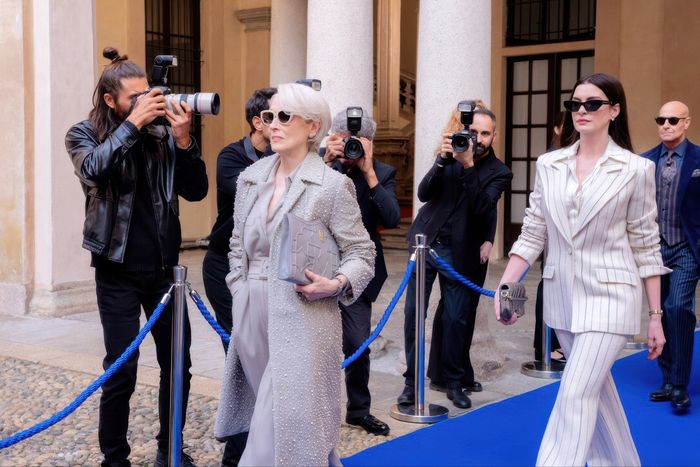
I by no means cared a lot concerning the unique The Satan Wears Prada, so it was a real shock that the melancholy charms of this 20-year-later sequel swept me off my ft. Then once more, anybody who works in media is sure to be gained over by this film’s bracingly practical evaluation of an trade crumbling underneath the ft of the previous few individuals making an attempt to make a residing in it. Anne Hathaway is endearing as an Andy who’s a bit wiser and a bit extra open to promoting out, whereas Meryl Streep will get some terrific line readings and bits of bodily comedy as Miranda. However it’s the pair collectively that makes the film sing: foes changed into allies out of necessity and likewise out of a shared religion within the worth of what they do. When Miranda turns to her former assistant and, in a uncommon second of unguardedness, asks her. “Don’t you simply love working?,” it’s heartbreaking in its sincerity. —AW

Picture: Strand Releasing
I’ve by no means seen drone footage used as thoughtfully as it’s in Our Land, the primary nonfiction characteristic by Lucrecia Martel. She turns the eerie impassivity with which a drone digital camera glides via the air into an asset by treating its perspective as a sort of God’s-eye view onto the battle between an Indigenous group in Argentina’s Tucumán province and the corrupt locals making an attempt to take their land. Martel’s movie is a damning, enraging have a look at the case of the homicide of a Chuschagasta activist, pulling again to supply a bigger account of the methods wherein the world’s Indigenous inhabitants was erased from the historic information. However it’s additionally artfully made, a reminder {that a} documentary might be pressing and informative whereas additionally being richly cinematic. —AW
Picture: Frederic Batier/A24/Everett Assortment
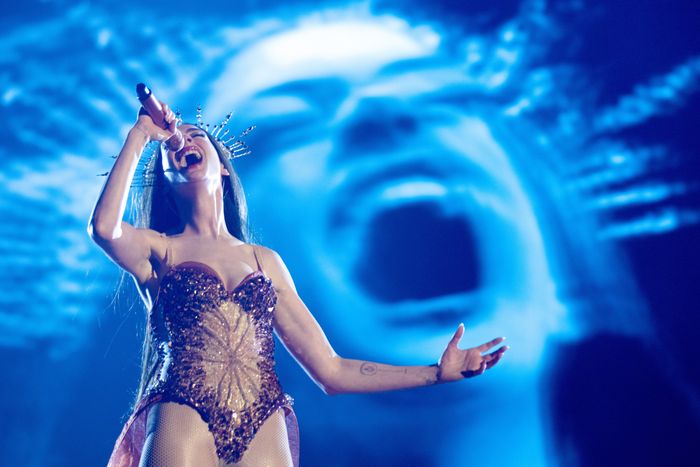
It doesn’t matter what sort of film David Lowery says he’s making. What he’s truly all the time making is a ghost story with phantoms and specters representing an array of regrets, sins, and betrayals. Mom Mary is usually weird, opaque, and a bit foolish, however it strikes with a surreal dream logic that is sensible as soon as Lowery’s prevailing curiosity in how the previous haunts us turns into clear. The movie is actually a two-hander between Mom Mary (Anne Hathaway), a pop star on the top of her profession who’s shedding sight of her creative ethos, and Sam (Michaela Coel), the style designer and collaborator who helped craft Mary’s look and persona earlier than that they had a devastating fallout. For the movie’s practically two-hour run time, Hathaway and Coel glower and stab at one another with pointed questions on their beliefs and their histories — and look completely attractive doing it. The pleasures of Mom Mary are primarily aesthetic and stylistic, however the girls’s performances floor the movie as a consideration of how artwork can both bleed you dry or infuse you with new creativity. Lowery ought to by no means surrender his ghosts, wacky as they may generally be. —RH

Picture: Janus Movies/Everett Assortment
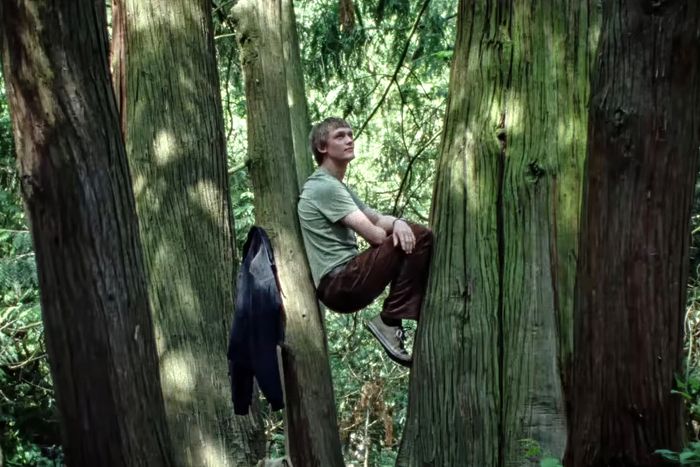
Blue Heron is an autobiographical work pulled straight out of writer-director Sophy Romvari’s childhood, from the interval when her dad and mom, each Hungarian immigrants, moved their household of six into a brand new home on Vancouver Island. However what it actually looks like is a séance, a manner of utilizing cinema not simply to place the previous onscreen however to commune with it — to interrogate it for details about her troubled eldest brother, Jeremy (Edik Beddoes), that her youthful self was unable to know on the time. It’s a young however devastating work that exists within the netherworld between documentary and fiction, the place the innate artificiality of re-creating one thing that truly occurred permits a filmmaker to get to a higher reality. —AW

Picture: Brian Roedel/IFC Movies/Everett Assortment
Daniel Goldhaber and Isa Mazzei’s movie isn’t a remake of the notorious 1978 exploitation landmark Faces of Loss of life a lot because it’s a intelligent, nastily-contemporary riff on what the unique represents — not simply the blurring of what’s actual and what’s not however the urge to rubberneck at gore and deal with the power to be unshaken by it as some extent of pleasure. Barbie Ferreira performs a content material moderator who begins fixating on whether or not a collection of movies which were flagged for examination may truly comprise actual murders, an obsession that places her on a collision course with a serial killer (Dacre Montgomery) who’s simply as compulsively on-line. The result’s an uncommonly entertaining horror movie centered on a personality with private causes to need the unimaginable: for everybody to cease approaching atrocity as spectacle at a time after we’ve turned the whole lot into content material. —AW

Picture: Vertical Leisure/Everett Assortment
Riz Ahmed is a pure at twitchiness, contorting that delicately featured face into frowns, grimaces, and squints reflecting an interior disquiet. It served him nicely in Nightcrawler, The Night time Of, and Sound of Metallic, and it makes his model of Hamlet believably self-loathing, a high quality that too many diversifications skimp on. In filmmaker Aneil Karia’s model of Shakespeare’s enduring basic, the cloistered nature of London’s ultrawealthy South Asian group serves because the backdrop for a claustrophobic, eerie strain cooker. All of the core components of the play are there: Hamlet’s father returning as a ghost (Avijit Dutt), Hamlet changing into satisfied that he must kill his uncle (Artwork Malik), Hamlet pushing away everybody — together with his lover, Ophelia (Morfydd Clark) — to pursue vengeance. In any other case, the variation is stripped down, sloughing off main parts of Shakespeare’s textual content to as a substitute heart on Ahmed’s more and more sweaty and off-kilter efficiency. In one of many movie’s greatest reimaginings, Karia levels the play’s iconic “To be, or to not be” speech in a automotive as Hamlet’s dashing down a freeway; with the digital camera roaming round contained in the car, Hamlet takes his fingers off the wheel, closes his eyes, and lets the automotive simply glide. It’s Hamlet as a dying want, an imaginative learn of a play whose loneliness and viciousness Ahmed carries in his physique. —RH

Picture: Neon/Everett Assortment
Based mostly on a wisp of an indie sport wherein the participant navigates a collection of train-station passages that kind a seemingly closed circuit, director Genki Kawamura’s thriller might very nicely be the best video-game adaptation to this point — although that bar is very low. There’s a real magnificence to the way in which that Kawamura incorporates the theme of parental nervousness into his supply materials’s easy however eerie premise, making the film really feel prefer it’s constructing on the essence of the gameplay reasonably than being trapped by so many Möbius-strip passageways. As a protagonist credited solely because the Misplaced Man, star Kazunari Ninomiya is usually left alone onscreen to information us via the commercial purgatory wherein he finds himself whereas providing us perception into the interior terrain of his character — a person who has been residing in an emotional limbo lengthy earlier than he will get caught in a literal one. —AW

Picture: Neon/Everett Assortment
A type of compact footage Steven Soderbergh tosses out yearly with the seeming effortlessness of somebody making a stack of pancakes, The Christophers is a deceptively easy two-hander starring Ian McKellen and Michaela Coel as artists at completely different ends of the movie star spectrum. It’s a sly dramedy that sends the struggling Lori Butler (Coel) into the orbit of Julian Sklar (McKellen), a legend of the ’60s and ’70s residing off the fumes of his fame after not having been in a position to paint for many years. However whereas The Christophers initially looks like it will likely be a sort of lo-fi heist movie, as Julian and Lori have interaction in what is actually a chronic duel, feinting and jabbing throughout generations, providing up deceptions and hard-fought moments of vulnerability, it reveals itself to as a substitute be a pair of complicated portraits, a diptych of topics who really feel hopelessly wounded by an artwork world from which they however need respect. —AW

Picture: Greenwich Leisure/Everett Assortment
In his directorial debut, Matthew Shear stars as a bumbling law-school dropout named Sam who’s caught in an anxiety-ridden stasis after the lack of his paralegal job. However his movie, a bittersweet indie about two individuals whose lives don’t intersect a lot as they drift collectively, can be a showcase for Amanda Peet, in her first large display screen position in years as Dianne, an actor whose once-promising profession and marriage to David (Alessandro Nivola), a musician with a case of arrested improvement, appear to have each stalled out. When Sam finally ends up working as a nanny and caring for the couple’s three daughters, he finds himself falling in love together with his employer, who’s each conscious of how comfy her monetary state of affairs is and the way sad and misplaced she’s been feeling. Peet is susceptible and brittle and radiant as a girl who’s undecided how one can ask for assist as a result of she isn’t satisfied that she wants it. —AW

Picture: 1-2 Particular/Everett Assortment
Radu Jude has made two of my favourite films of this millennium, and whereas Kontinental ’25 isn’t as much as the extent of both 2021’s Unhealthy Luck Banging or Loony Porn or 2023’s Do Not Count on Too A lot From the Finish of the World, it nonetheless options loads of the Romanian filmmaker’s signature touches, from a caustic humorousness to a eager eye for the impossibility of making an attempt to be an excellent individual whereas additionally making an attempt to not get floor to bits within the gears of world capitalism. Eszter Tompa performs Orsolya, a Hungarian girl who works as a bailiff within the Transylvanian metropolis of Cluj and who has to supervise the eviction of a squatter within the basement of a lately bought condominium constructing that goes horribly mistaken. Jude is aware of how one can twist the knife however may also be surprisingly beneficiant concerning the absurdity of simply making an attempt to get by, and Orsolya’s subsequent spinout brings the movie to some unexpectedly farcical locations. —AW

Picture: Music Field Movies/Courtesy Everett Assortment
“I killed an Arab.” These are the primary phrases uttered by Meursault (Benjamin Voisin), the protagonist of François Ozon’s The Stranger, and already we will sense that this adaptation of Albert Camus’s basic 1942 novel has been given at the least one special approach. By foregrounding the second, Ozon makes it clear he understands the thorny nature of the fabric he’s adapting. The Stranger is about an virtually completely passive and unreflective character, a person whose sole second of company seems to be the random act of violence that condemns him to the guillotine. By way of delicate shifts in his storytelling, Ozon brings forth one other dimension to Meursault’s actions. On the identical time, this can be a completely devoted adaptation of the novel. Taking pictures in attractive black and white, Ozon’s strategy is tactile, sensuous. The digital camera focuses on the on a regular basis textures and sensations of Meursault’s life to relay the character’s direct experiences, as Camus did together with his prose. Most necessary, the director captures Meursault’s silence. Meursault could also be misplaced in society’s eyes — a chilly, troubling determine seemingly unaware of our most elementary rituals — however he additionally displays the basic silence of the world. —BE

Picture: 1-2 Particular/Everett Assortment
What’s beguiling about Christian Petzold’s newest, a small movie that however snags on the coronary heart, are the methods wherein it depicts the comforts of the pretense its characters all implicitly comply with. Sad Berlin music pupil Laura (performed by Petzold’s present main woman of alternative, Paula Beer), who survives a automotive accident that claims the lifetime of her boyfriend, acts as if there’s nothing unusual about her request to stick with the lady who discovered her on the crash website. Her new caretaker, Betty (Barbara Auer), in the meantime, behaves as if she doesn’t have extremely private causes to dote over this whole stranger. The fairy-tale qualities of the setup disguise some very actual ache on the a part of characters who, we regularly understand, are engaged in a sort of spontaneous, therapeutic train they’ll’t acknowledge. —AW

Picture: Janus Movies/Everett Assortment
The Ukrainian director Sergei Loznitsa’s first narrative characteristic in seven years is a mesmerizing and Kafkaesque story of a younger lawyer in search of justice in 1937 on the top of Stalin’s brutal purges. Though he meets roadblocks all alongside the way in which, the protagonist’s dedication and persistence appear to serve him nicely. First, he manages to fulfill with the person he’s in search of to defend: an aged Bolshevik who was jailed underneath false pretenses and who reveals him his wounds from the torture he has endured in captivity. Then our hero travels to Moscow to talk on to the nation’s chief prosecutor, to plead with him to open an investigation into the prisoner’s remedy. What distinguishes this movie is just not its general narrative trajectory (which reads extra like a bitter cosmic joke than anything) however reasonably how Loznitsa subtly colours on this character’s journey via the halls of energy. Within the upside-down universe of Stalin’s Russia, this younger idealist’s diligence and persistence might be his biggest failings. He thinks he has company; he assumes he’s transferring up the chain of command; he believes that by going above everybody’s heads, he’s outflanking the criminals who’ve sullied Soviet justice. Actually, he’s unwittingly enacting a charade, every step on his path extra meaningless than the final. —BE

Picture: Music Field Movies/Everett Assortment
Petra Volpe’s movie was the Swiss submission to the Oscars this yr however didn’t find yourself getting a nomination. That mentioned, it’s a candidate for a probably extra profitable award: the title of a movie almost definitely to scratch the itch for The Pitt followers jonesing for extra medical-procedural goodness. Set over the course of a night at a Swiss hospital that’s concurrently understaffed and far nicer-looking than any American equal, Late Shift follows a nurse named Floria Lind (Leonie Benesch) who arrives at work to search out the ward practically full and one in all her colleagues out sick. She’s put in an unimaginable place, always being confronted with new fires to place out and unable to offer the eye and time she’d prefer to sufferers who’re determined and afraid. Even when it feels a bit blunt in its characterizations, Late Shift retains you teetering on the sting as you anticipate its heroine to slide up or to interrupt down. —AW

Picture: Jonathan Olley/MGM/Everett Assortment
It’s a bit shocking how nicely Andy Weir’s books — which may really feel as if they’re roughly 70 p.c math equations — have remodeled into crowd-pleasers, first with The Martian and now with Venture Hail Mary, however that’s the ability of an excellent adaptation staff. With Venture Hail Mary, administrators Phil Lord and Christopher Miller and screenwriter Drew Goddard acknowledged that one of the simplest ways to make this story work for the large display screen was to basically make it a Star Wars film, wherein a lovable creature and an enthralling rogue staff as much as save the world. That strategy is dropped at vibrant life via Ryan Gosling and puppeteer James Ortiz, who infuse unlikely astronaut Ryland Grace and good alien Rocky with actual optimism, affection, and sincerity as they work to determine why their respective suns are being consumed by microorganisms and the way they’ll every make it dwelling. The enjoyment of this film isn’t within the infinite wisecracking however within the sensible results and physicality driving Gosling’s and Ortiz’s performances: the wacky manner the previous throws his physique round his spaceship when he wakes up in 2032 with no reminiscence of how he acquired there, the delicate intonations within the latter’s voice as Rocky works via numerous functions of the phrase amaze. Gosling and Ortiz are a complementary pair, and their chemistry provides to Venture Hail Mary a socially-minded perception within the energy of borderless, open-armed collaboration that Weir would possibly deny exists in his work however that Lord, Miller, and Goddard rightly perceive as the purpose of any sci-fi story price telling. —RH

Picture: Dustin Rabin/A24/Everett Assortment
Other than the horrible podcast-recording practices on show, Ian Tuason’s characteristic debut is a low-budget Canadian horror film that does lots with a bit. It leans all the way in which into its claustrophobic situation, which finds podcaster Evy (Nina Kiri), who has been spending her days alone in her childhood dwelling together with her dying mom, slowly splintering aside because the boredom and stress of her state of affairs mix with the eeriness of a set of mysterious audio recordsdata which will very nicely be haunted. The movie’s greatest trick, one which Tuason and cinematographer Graham Beasley make frequent use of, is arranging pictures stuffed with unfavorable house in order that an inky void swims behind Evy as she sits with noise-canceling headphones on, oblivious to what is likely to be happening round her — an strategy that makes the more and more unusual soundscapes she’s taking in all of the extra unsettling. —AW

Picture: MUBI/Everett Assortment
The Italian metropolis of Naples, with Mt. Vesuvius ceaselessly looming throughout its bay, has all the time existed within the shadow of apocalypse. Not less than that’s the temper director Gianfranco Rosi evokes in his mesmerizing documentary. The apocalypse he presents is not only the legendary one which destroyed the traditional Roman city of the movie’s title however an ongoing one which encompasses the calamities of our fashionable period in addition to the rejuvenation that generally accompanies destruction. It begins with Pliny the Youthful’s contemporaneous description of the devastation of Pompeii and Herculaneum however intercuts the pictures of damage with glimpses of the fashionable metropolis. That is an space of standard seismic exercise in addition to wildfires. It has additionally been plundered for hundreds of years by grave robbers and smugglers. Rosi’s high-contrast photos carve shadows throughout his topics’ faces and our bodies, rendering them not dissimilar to the timeless statues and friezes amongst which they roam. The movie’s observational qualities serve a broader quest for profundity and wonder. This isn’t a fly-on-the-wall documentary; it’s a Caravaggio-on-the-wall documentary. —BE

Picture: Dean Rogers/Amazon MGM Studios/Everett Assortment
Everybody says they need films for adults; right here you go. Crime 101 is a superbly entertaining, competently made heist image of the sort that this trade used to churn out with some regularity and now can’t be bothered to create exterior of Quick & Livid branding. Nobody in Crime 101 is tasked by a secret authorities company with saving the world, and there aren’t even that many wild chases via the streets of Los Angeles. What Bart Layton’s movie has as a substitute is deep inside characterwork from a note-perfect ensemble led by Chris Hemsworth, Halle Berry, and Mark Ruffalo, every of whom represents a unique thread of Crime 101’s interwoven story: a jewel thief (Hemsworth) rising uninterested in his loner tendencies, an insurance coverage dealer (Berry) who has been handed over for a promotion one too many occasions, and a detective (Ruffalo) satisfied that the current spate of jewel thefts throughout Los Angeles are the work of 1 man. Over 140 well-paced minutes, Crime 101 drops us into every of the trio’s lives, attracts them collectively, and reveals us how they’re threatened by a horny-for-violence younger thief performed by Barry Keoghan. All of it leads as much as a satisfying, western-influenced climax whose style beats are elevated by the solid’s performances, notably Ruffalo’s head-tilted riff on Columbo’s “Only one other thing” questioning. —RH

Picture: Neon/Everett Assortment
You don’t have to be aware of Matt Johnson and Jay McCarrol’s net collection turned TV present Nirvanna the Band the Present to get pleasure from its big-screen continuation. I’d even argue that the film is healthier as a stand-alone discovery that introduces you to Johnson and McCarrol’s fictionalized variations of themselves whereas additionally blowing up their present’s fundamental premise by way of a Again to the Future–fashion plot. The entire pleasant caper, which finds Johnson and McCarrol struggling to get again from the yr 2008 after unintentionally time-traveling with the assistance of a discontinued Canadian mushy drink, is powered by the pair’s DIY ingenuity, willingness to probably get arrested, and, most necessary, a again catalogue of footage they’ve been capturing for over a decade and a half. It’s an absurd Toronto journey that has the slightest contact of Boyhood-esque poignancy. —AW

Picture: Warner Bros./Everett Assortment
Emerald Fennell’s adaptation of Wuthering Heights has the tunnel-vision horniness and girlish aesthetic sensibility of a high-school freshman who has been assigned to learn Brontë at school whereas tearing via a pile of specific bodice rippers underneath the covers at dwelling. Asking if it’s devoted to the basic 1847 model is like asking if a tween crush on a boy-band member is real love — it’s inappropriate and doesn’t do justice to the uniquely hectic emotions of its personal feverish expertise. Jacob Elordi broods and flashes a gold tooth, Margot Robbie flounces round in a crimson vinyl skirt, snails lustily slime their manner throughout windowpanes, and the whole lot works out completely terribly for all these magnificently terrible characters. —AW

Picture: Chris Harris/A24/Everett Assortment
Harry Lighton’s salty-sweet directorial debut is, chain collars and ass-eating apart, surprisingly delicate at its core. It’s extra of a journey of self-discovery than a sexual one — like fellow BDSM-inflected A24 launch Babygirl, a narrative of somebody slowly studying to articulate what it’s they need. Whereas Harry Melling’s guileless Colin, who’s always in awe to search out himself concerned with the strapping blond biker dom who approaches him on the pub sooner or later, offers the movie with its melancholy coronary heart, Alexander Skarsgård offers the humor as his love curiosity, Ray. Half the joke is his look — this absurdly sizzling man who seems like a Tom of Finland sketch that has sprung to life and determined to reside in suburban London — however as punch strains go, it’s an excellent one. —AW

Picture: Brook Rushton/Walt Disney Studios/Everett Assortment
Rachel McAdams is such a scream on this Sam Raimi throwback that she virtually makes you neglect her character would make much more sense performed by, say, an Workplace-era Phyllis Smith. Nonetheless, the comedic thriller a couple of resentful workplace drone stranded on a Pacific Island together with her smug new nepo-baby boss (Dylan O’Brien) works as a result of McAdams is unerringly humorous and extremely sport. Whether or not she’s hurtling herself right into a scene wherein she will get drenched in blood and mucus whereas searching a boar or convincing you that her character is totally able to crafting a restaurant-worthy sashimi platter out of things she has foraged alongside the shore, she’s the proper accomplice for Raimi’s combo of gross-out and grimly amusing. —AW

Picture: Cineverse Leisure/Everett Assortment
Ratchapoom Boonbunchachoke’s droll directorial debut begins as a comedy about ghosts possessing home equipment at an electronics manufacturing unit and ends as a meditation on changing into a collaborator working in opposition to the pursuits of your individual variety. At its heart is Nat (Davika Hoorne), the late spouse of the manufacturing unit proprietor’s son, who isn’t able to let dying cease her from being together with her husband and beginning the household they all the time talked about. The movie’s shiny colour palette and deadpan tone — the scene of Nat seducing her partner in her new kind as a vacuum cleaner is surreally hilarious — belie how pointed it will definitely turns into. Nat, as determined within the afterlife as she was in life to show herself worthy, begins serving to eradicate different ghosts in return for safety for herself, changing into as a lot a determine of complicity as tragedy. —AW

Picture: Sony Footage/Everett Assortment
Though it’s, in some ways, a extra typical movie than final yr’s 28 Years Later, Nia DaCosta’s follow-up to Danny Boyle and Alex Garland’s deranged zombie sequel can also be a extra psychologically acute effort. A lot of it follows a weird gang of blond-wigged, tracksuited, acrobatic zombie killers, all answering to the identify of Jimmy and led by a psychopath calling himself Jimmy Crystal (Jack O’Connell). Their exploits are intercut with the efforts of the nutty hermit Dr. Ian Kelson (Ralph Fiennes) as he tries to search out methods to commune with the undead and perhaps even reverse the “rage virus” that has destroyed humanity. Kelson spends quite a lot of his time dosing and chilling with the large and brutal “alpha” zombie Samson. All these little paths into the characters’ interior lives begin to cohere right into a imaginative and prescient of human cruelty. DaCosta works in these concepts subtly though The Bone Temple itself is just not what one would possibly name delicate. Actually, it’s downright loony tunes: Its scenes of crazed flamboyance match into the movie’s general sense of a civilization caught in time, of individuals mentally frozen in the mean time of collapse. The one method to transcend and survive a dying world, it suggests, is to chop unfastened and discover methods to be your self. —BE

Picture: Watermelon Footage
Cherien Dabis’s movie is an ethical fable within the guise of an epic household drama. Stretching throughout 145 minutes, the image opens with a spirited Palestinian teen, Noor (Muhammad Abed Elrahman), as he’s shot throughout a West Financial institution road protest someday in 1988. Then the movie flashes again to 1948, and we discover ourselves within the lifetime of a well-to-do Palestinian household in Jaffa. Because the film proceeds, we see the destiny of this household in 1978, and 1988, and past. There’s a closed-off fashion to the drama that displays the cloistered nature of the characters. As battle and displacement eat them, their isolation grows. And there’s energy within the sheer spectacle of time: Charismatic younger males grow to be previous and embittered; once-vivacious kids develop as much as be fathers themselves, who’re then harassed and stricken by Israeli troopers. These historic episodes display the endless cycles of humiliation Palestinians have needed to undergo. The primary half of the film, with its grim journey via the a long time, seems to be a prologue to the story of the teenage Noor’s destiny. Even then, the movie has extra shocking strikes left in it. All That’s Left of You isn’t actually in search of empathy. In its personal uneven however suave manner, it reveals us the alienation that survival generally requires. By the top, I used to be destroyed. —BE

Picture: Row Okay Leisure
Gus Van Sant’s newest sticks typically to the information in its portrayal of Tony Kiritsis (Invoice Skarsgård), an aspiring businessman who sooner or later in February 1977 walked into the workplaces of Meridian Mortgage and kidnapped his dealer, Dick Corridor (Dacre Montgomery), wrapping a wire connected to a shotgun across the man’s neck. Tony claimed the mortgage firm screwed him over after he took out loans to develop a once-neglected piece of actual property the place he supposed to construct a shopping mall. In different phrases, this gun-wielding kidnapper was a person who believed within the revenue motive and the concept laborious work and ingenuity would finally repay. Tony has totally purchased into the dream, and Skarsgård performs him with excitable, boyish humor, virtually as if the entire thing had been a sport. He’s only a little one, momentarily rebelling in opposition to the world that made him. One thing comparable happens with Dick, who’s an government in a enterprise run by his father (Al Pacino) and is fairly powerless himself. Dick can also be a baby of a system that doesn’t love him again, solely on this case it’s his literal household. Each he and Tony have been sacrificed to the almighty greenback. There’s a strong civilizational metaphor on this movie’s central picture of two damaged capitalists locked in a murderous standoff. —BE
Join the Vulture Every day
An leisure publication for the pop-culture obsessed.
Vox Media, LLC Phrases and Privateness Discover

