


Over the weekend, a clip of Magic Johnson went viral on Twitter. The model my algo fed me has two million views and a whole lot of feedback. There are a number of extra variations.
Within the interview, Magic recounts a well-recognized enterprise remorse: Again in 1979, when he was popping out of Michigan State as essentially the most thrilling younger basketball participant in America, Nike supposedly wished to signal him to a sneaker deal.
The issue, based on Magic, was that Nike didn’t have the cash being supplied by extra established shoe firms. As Magic tells it, Phil Knight basically stated: We can’t pay you want Converse can, however we may give you inventory.
Magic selected the money.
Within the newest model of the story, Magic says Nike later “ran the analytics” and concluded that if he had taken the inventory deal in 1979, it might be value $1 billion as we speak. Here is the clip:
Magic Johnson says turning down Nike in 1979 value him over $1,000,000,000
“Nike, after I was younger, wished to signal me, however give me inventory. Phil Knight stated, ‘I haven’t got the cash they’ve, however I received inventory'”
“They ran the analytics. If I had did that deal in 1979, it might be over… pic.twitter.com/7VQVSbtKQ6
— dank (@cptdankkk) June 19, 2026
This isn’t the primary time Magic has advised some model of this story. He tells the story mainly any time anybody asks him about it. The story was even referenced within the HBO collection “Successful Time: The Rise of the Lakers Dynasty.” Within the “Successful Time” model, Magic didn’t lose $1 billion. He misplaced $5.2 billion. The present even included this graphic as a shocking punch line:
$5.2 billion
If this story had been true, it might arguably be essentially the most painful monetary mistake in sports activities enterprise historical past.
However there may be one teeny tiny downside with the story Magic loves to inform: It’s in all probability not true.
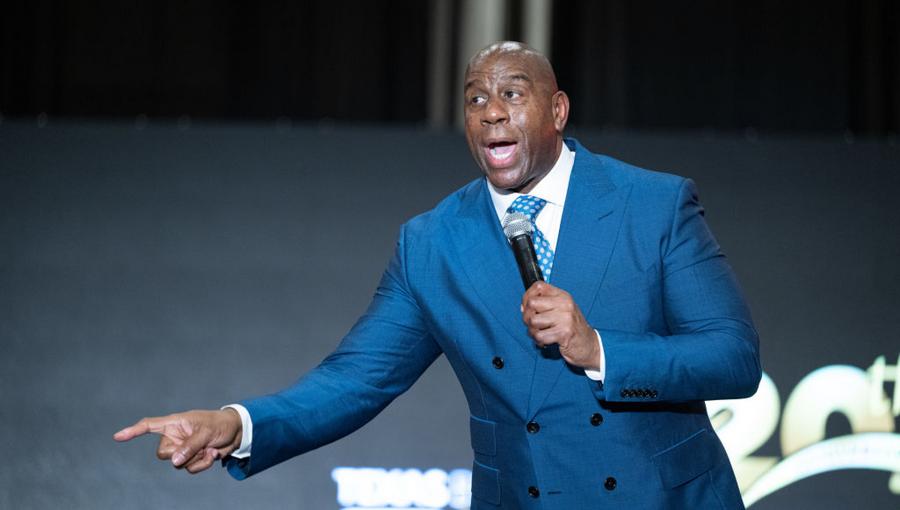
Marcus Ingram/Getty Pictures
Is This Story True?
There have been a variety of individuals who have referred to as BS on this story. Neither Nike nor Phil Knight has ever confirmed it. Moreover, it’s typically agreed that Michael Jordan was the primary athlete to obtain inventory from Nike as a signing incentive. Jordan was additionally the primary Nike athlete to earn a share of gross sales. Maybe most critically, Magic had already signed with Converse by July 1979. That was simply 4 months after he gained the NCAA Championship and only a few weeks after his Sophomore yr ended, and he determined to show skilled.
If this Nike supply was actual, when did it occur? Inside a number of weeks of graduating? Earlier than Converse locked him up? Smells fishy.
However let’s play satan’s advocate. Assume Phil Knight actually did supply Magic an enormous slice of the pre-IPO pie that ultimately translated into 100,000 company shares when Nike went public in December 1980.
Nike’s IPO launched at $22 per share. Following many years of inventory splits, these unique 100,000 shares would equal roughly 12.8 million shares as we speak.
With Nike buying and selling round $45 a share, that uncooked inventory fairness could be value roughly $580 million.
That’s an astronomical fortune—however it isn’t $1 billion, and it’s positively not the present’s fictional $5.2 billion.
The Dividend X-Issue
Nonetheless, Magic’s declare of $1 billion is not fully loopy in the event you consider one thing most individuals overlook: Dividend Reinvestment (DRIP).
Over a 46-year timeline, holding onto 12.8 million shares of a powerhouse firm like Nike means accumulating quarterly dividend checks for many years. If Magic had mechanically reinvested each single a kind of dividend checks again into shopping for extra Nike inventory moderately than cashing them out, the compounding impact would simply push his whole portfolio worth previous the $1 billion mark.
So, Magic’s math truly checks out—however provided that he by no means touched a single dime of the cash for almost half a century.
Although these hypotheticals are all the time enjoyable to dive into, there’s one different factor we frequently do not consider. It is onerous to think about he would not have offered some or all of his shares in some unspecified time in the future within the final 50ish years, both to construct his wealth or to spend money on one among his many enterprise ventures.
Johnson has performed very nicely for himself anyway, with a internet value of $1.6 billion. So whereas he might kick himself for passing on Nike, even when it might have by no means truly occurred, he is made loads of nice strikes all through his life, each on and off the courtroom.

